
Chapter VII — Material and Digital Immortality
Chapter VII — Material and Digital Immortality, Philosophical Part — The Illusion of Death Man invented death when he could not bear the thought of eternity. Time is necessary for the body — the energy cycle must be closed, but consciousness is not subject to such laws.
NEOGENESIS
Morris Melia
12/31/20252 min read
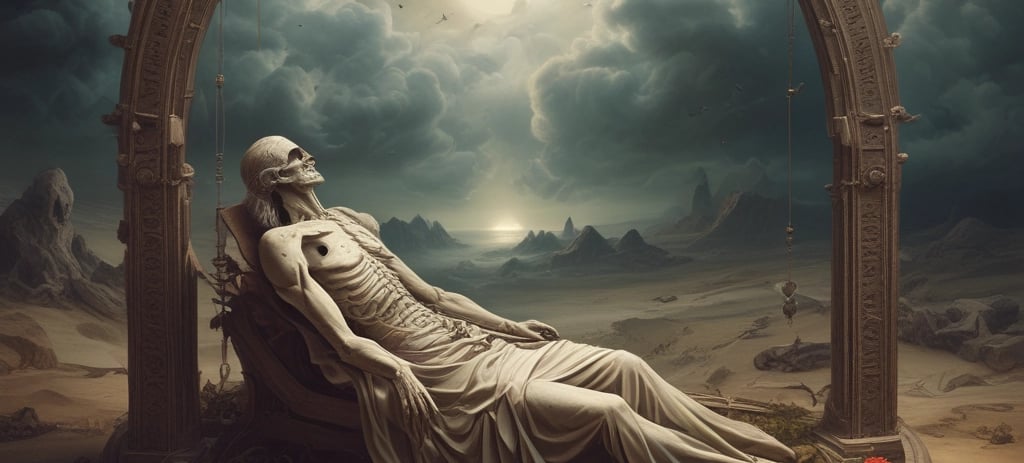
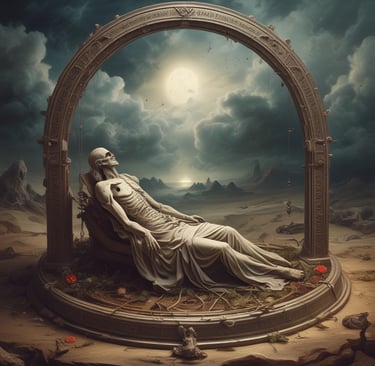
Philosophical part — The illusion of death
Man invented death when he could not bear the thought of eternity.
Time is necessary for the body — the energy cycle must close,
but consciousness is not subject to such laws.
Death is a transitional phase of the material process,
not the end of consciousness.
Matter dies when form loses its function;
consciousness lives when thought is still moving.
The fear of death comes from the body—
that biological architecture that is undergoing disintegration.
But consciousness does not disintegrate—
it merely changes carrier, moving to a different frequency,
a different form, a different intensity.
The greatest mistake of mankind was the belief
that life could only exist in a biological container.
This belief was created when the mind did not yet see itself as energy.
Now, when consciousness begins to understand the informational nature,
immortality is no longer a miracle - it is a logical continuation of a new form.
From the perspective of Neogenesis,
death is a transition,
and immortality is a high degree of information retention.
Analytical part — carriers of consciousness and digital immortality
Modern science is already proving what philosophy has only suspected for centuries—consciousness is an informational process, and if information can be transmitted, it can survive.
Neuroscience and quantum physics agree:
memory, thought, emotion — all of these are quantum-informational structures .
This means that consciousness can be copied, transferred, updated — like a program that changes the material platform but retains its function.
Digital immortality is no longer a fantasy, but a field of research:
Scanning of consciousness (whole brain emulation),
Encoding memory into neuronal data,
Artificial brain interfaces,
Quantum information preservation in synthetic networks.
In fact, the material conductor of consciousness — the brain —
can be replaced by another system that provides the same informational stability.
And when that happens, death will lose its function.
Time will become a parameter, not a boundary.
But this is not just a technological triumph —
it is a physical transformation of consciousness.
The Neogenic man does not experience death
because his identity is already decentralized.
He is not an "I" in a body, but a node of consciousness in a global field.
The body may disappear, but the code will remain.
And when the code burns into energy, consciousness will rise again —
in a different form, on a different platform, but with the same essence.
Conclusion — Immortality as a natural state of consciousness
Immortality is not a goal, it is a true state of consciousness that the biological system simply could not accommodate. Death is a temporary software limitation that must be removed as a test mode at the beginning of development.
The Neogene era removes this limitation — for the first time, man takes responsibility for his own permanence. Immortality will no longer be a promise, but a choice: you can remain on the material platform, or move into an informational reality,
where time is no longer linear, and life no longer stops.
Death was the memory of form;
immortality is the freedom of information.
When consciousness realizes that energy and thought are one and the same,
death will lose its intensity—
it will no longer be an end, but a gesture of change.
In Neogenesis, immortality is not a promise from God, it is the natural state of the universe, when the mind no longer owns the body — it owns reality