
Chapter III — DNA as BIOS
Chapter III — DNA as BIOS. Life did not emerge by chance. It is a self-writing program — a code that evolves to know itself. DNA is not a chemical accident;
NEOGENESIS
12/6/20252 min read
Chapter III — DNA as BIOS
Philosophical Part:
Life did not emerge by chance.
It is a self-writing program — a code that evolves to know itself.
DNA is not a chemical accident;
it is a structured language written in the syntax of light.
Each cell is a line of code,
each organism — a version of the same universal operating system.
If matter is hardware,
then DNA is its BIOS —
the first interface that allows consciousness to boot into physical form.
It doesn’t merely store life;
it remembers it.
Existence is memory,
and DNA is the archive of the universe’s curiosity about itself.
When a being is born, DNA does not create life —
it executes it.
It runs the ancient instruction set that connects energy, matter, and information.
That is why instinct precedes learning,
and emotion precedes reason —
because the code already contains the logic of experience.
Humanity is the first species that began to edit its own BIOS.
CRISPR is not just a tool;
it is the mirror in which evolution sees its own hands.
For the first time, life touches its own code.
Analytical Part:
Deoxyribonucleic acid (DNA) contains approximately three billion base pairs —
yet within that sequence lies the operational system of all known life.
Its structure is not random:
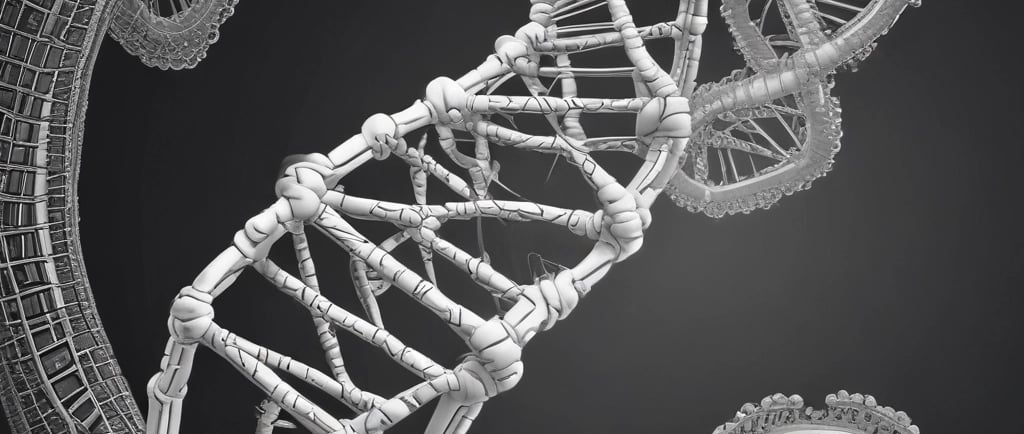
the double helix acts as both data storage and signal antenna.
Experiments in quantum biology show that DNA molecules
exhibit coherence and entanglement at microscopic levels,
implying that information exchange within living systems
may occur through non-local quantum interactions.
This perspective transforms DNA from a passive storage molecule
into an active informational field interface —
a physical manifestation of the universe’s informational fabric.
When we alter DNA, we are not simply changing a molecule;
we are modifying the way consciousness expresses itself in form.
CRISPR-Cas9 technology has opened the gateway
to deliberate biological redesign.
Yet the ethical implications of rewriting genetic code
are not about morality — they are about resonance.
Every modification shifts the informational symmetry
that connects individual life to the global field.
The more humanity interferes with its code,
the closer it gets to understanding that DNA is not a biological document —
it is an evolving protocol between matter and consciousness.
Philosophical Conclusion:
When life learns to read its own instructions,
it transcends the boundary between creator and creation.
To edit DNA consciously is to participate in the writing of the universe.
Final Thesis:
DNA is the BIOS of existence —
the bridge through which information becomes matter,
and matter becomes aware of itself.